| ||||||||||||||||||||||||||||||||||||||||||||||||||||||||||||||||||||||||||||||||||||||
| USES OF NATURAL VEGEGATION | ||||||||||||||||||||||||||||||||||||||||||||||||||||||||||||||||||||||||||||||||||||||
| ||||||||||||||||||||||||||||||||||||||||||||||||||||||||||||||||||||||||||||||||||||||
Sunday, 31 January 2016
Natural Vegetation & Wildlife


Solar System
The Solar System consists of the Sun and the other celestial objectsgravitationally bound to it: the eight planets, their moons, five currently identifieddwarf planets and their seven known moons, and billions of small bodies. This last category includes asteroids, Kuiper belt objects, comets, meteoroids andinterplanetary dust. In broad terms, the charted regions of the Solar System consist of the Sun, four terrestrial inner planets, an asteroid belt composed of small rocky bodies, four gas giant outer planets, and a second belt, called the Kuiper belt, composed of icy objects. Beyond the Kuiper belt lies the scattered disc, the heliopause, and ultimately the hypothetical Oort cloud. In order of their distances from the Sun, the planets are Mercury, Venus, Earth, Mars, Jupiter, Saturn, Uranus, andNeptune. Six of the eight planets are in turn orbited by natural satellites, usually termed "moons" after Earth'sMoon, and each of the outer planets is encircled by planetary rings of dust and other particles. All the planets except Earth are named after gods and goddesses from Greco-Roman mythology. The five dwarf planets arePluto, Makemake, and Haumea, the three largest known Kuiper belt objects; Ceres, the largest object in the asteroid belt; and Eris, the largest known object in the scattered disc.
 Oberon is the outermost major moon of the planet Uranus. It is the second largest and second most massive of Uranian moons, and the ninth most massive moon in the Solar System. Discovered by William Herschel in 1787, Oberon is named after a character in Shakespeare's A Midsummer Night's Dream. Its orbit lies partially outside Uranus'smagnetosphere. Oberon consists of approximately equal amounts of ice and rock, and is likely differentiated into a rocky core and an icy mantle. A layer of liquid water may be present at the core/mantle boundary. The surface of Oberon, which is dark and slightly red in color, appears to have been primarily shaped by asteroid and comet impacts. It is covered by numerousimpact craters reaching 210 km in diameter. Oberon possesses a system of canyons (scarps) formed as a result of the expansion of its interior during its early evolution. This moon probably formed from the accretion disk that surrounded Uranus just after the planet's formation. As of 2010, the Uranian system has been studied up close only once: by the spacecraft Voyager 2 in January 1986. It took several images of Oberon, which allowed mapping of about 40% of the moon’s surface

- ...that Yogi Rock (pictured) is a rock found on Mars by the Mars Pathfinder mission that looks surprisingly like Yogi Bear's head?
- ...that the Kuiper crater in the Kuiper quadrangle, named after Dutch American astronomerGerard Kuiper, has the highest albedo recorded on Mercury?
- ...that 6Q0B44E, a recently discovered satellite of Earth, is thought to be a large piece of space debris?
- ...that 17th century philosopher Cesare Cremonini refused to look at the Moon's mountains through Galileo's telescope, because Aristotle had proved the Moon was a perfect sphere?
- ...that ridges and escarpments in the Victoria quadrangle of the planet Mercury have been associated with the stresses caused by the sun slowing Mercury's rotation through tidal forces?
- ...that J002E3 was at first thought to be a new moon of Earth when discovered in 2002 but was later found to be the third stage of the Apollo 12 Saturn V?
- ...that the Tooting impact crater on Mars was named after the London suburb of the same name because the discoverer "thought [his] mum and brother would get a kick out of having their home town paired with a land form on Mars"?
- ...that 99% of the mass of the Carme group, a group of retrograde irregular satellites of Jupiter, is located inCarme?

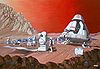
- ... that the first engineering analysis of a manned mission to Mars (artist's conception pictured) was made by Wernher von Braun in 1948, which included ten ships with seventy crewmembers?
- ...that water vapor is probably present in the tenuous atmosphere of Mercury, being brought to the planet by comets?
- ...that the Tagish Lake meteorite originally came from a part of the asteroid belt which existed when our solar system was being formed?
- ...that the trans-Neptunian object Eris (formerly known as 2003 UB313) is native to a distant region of our solar system known as the scattered disc?
Friday, 29 January 2016
Points to Know
Q.1 Which of the following countries has overtaken Thailand as the world's largest rice exporter in 2015?
a India bChina cJapan dVietnam
Q.2 Who among the following has been appointed as Uttar Pradesh Lokayukta by the Supreme Court on 28th January, 2016?
aRanjan Gogoi bSanjay Mishra cVirendra Singh dVijendra Singh
Q.3 The index issued by the Transparency International reported one of the following countries has tops 2015 global corruption index. Identify the country.
aSweden bFinland cDenmark dNew Zealand
Q.4 With which of the following states the Indian Railways on 27th January, 2016 entered into two separate agreements for the formation of joint venture companies (JVCs) with state governments.
aKarnataka and Kerala
bTamil Nadu and Kerala
cKerala and Andhra Pradesh
dTamil Nadu and Karnataka
Q.5 Around 165,000 students in 1,000 schools across India will benefit from CLIx, launched by Tata Trusts on 27th January, 2016, Tata Institute of Social Sciences and Massachusetts Institute of Technology. CLIx stands for…
aConnected Learning Classes
bConnected Learning System
cConnected Learning Institute
dConnected Learning Initiative
Q.6 US-based Cognizant on 27th January, 2016 has acquired, a global consulting and technology services company for an undisclosed amount. Name the company.
| a KBACE Technologies
bGetronics Technologies
cCapgemini Technologies
dScience Applications International Corporation
Q.7 Kellton Tech, a Hyderabad-headquartered firm with development centres in the country and the US, has acquired a Houston-based enterprise, cloud and analytics services provider in January, 2016. Name the company.
a Cloud Expo b3Leaf Systems cIlad Enterprise dIland Enterprise
Q.8 IT major HCL Technologies Ltd on 27th January, 2016 announced acquisition of one of the UK based company for £8 million (approx Rs 78 crore). Identify the company.
aPalace Software
bTatvaSoft UK Ltd
cPoint to Point Ltd
dMcLaren Technology Group
Q.9 Which of the following ace Indian shooter secured an Olympic quota for the country women's 10-meter air pistol event at the Asia Olympic Qualifier on 27th January, 2016?
a Heena Sidhu bSushma Ran cAnjali Bhagwat dApurvi Chandel
a India bChina cJapan dVietnam
Q.2 Who among the following has been appointed as Uttar Pradesh Lokayukta by the Supreme Court on 28th January, 2016?
aRanjan Gogoi bSanjay Mishra cVirendra Singh dVijendra Singh
Q.3 The index issued by the Transparency International reported one of the following countries has tops 2015 global corruption index. Identify the country.
aSweden bFinland cDenmark dNew Zealand
Q.4 With which of the following states the Indian Railways on 27th January, 2016 entered into two separate agreements for the formation of joint venture companies (JVCs) with state governments.
aKarnataka and Kerala
bTamil Nadu and Kerala
cKerala and Andhra Pradesh
dTamil Nadu and Karnataka
Q.5 Around 165,000 students in 1,000 schools across India will benefit from CLIx, launched by Tata Trusts on 27th January, 2016, Tata Institute of Social Sciences and Massachusetts Institute of Technology. CLIx stands for…
aConnected Learning Classes
bConnected Learning System
cConnected Learning Institute
dConnected Learning Initiative
Q.6 US-based Cognizant on 27th January, 2016 has acquired, a global consulting and technology services company for an undisclosed amount. Name the company.
| a KBACE Technologies
bGetronics Technologies
cCapgemini Technologies
dScience Applications International Corporation
Q.7 Kellton Tech, a Hyderabad-headquartered firm with development centres in the country and the US, has acquired a Houston-based enterprise, cloud and analytics services provider in January, 2016. Name the company.
a Cloud Expo b3Leaf Systems cIlad Enterprise dIland Enterprise
Q.8 IT major HCL Technologies Ltd on 27th January, 2016 announced acquisition of one of the UK based company for £8 million (approx Rs 78 crore). Identify the company.
aPalace Software
bTatvaSoft UK Ltd
cPoint to Point Ltd
dMcLaren Technology Group
Q.9 Which of the following ace Indian shooter secured an Olympic quota for the country women's 10-meter air pistol event at the Asia Olympic Qualifier on 27th January, 2016?
a Heena Sidhu bSushma Ran cAnjali Bhagwat dApurvi Chandel
New Commers
Q.1 Which among the following mobile apps has been launched by the Agriculture Minister Radha Mohan Singh for farmers in New Delhi on 23rd December, 2015?
a e-kishan bCrop Insurance cAgriMarket Mobile dBoth B and C
Q.2 Defence Minister Manohar Parrikar will dedicate to the nation, the first cable-stayed bridge of North India in December, 2015. It will be constructed in…
aPunjab bNew Delhi cHimachal Pradesh dJammu and Kashmir
Q.3 Name the Indian-American tumour scientist, who has won US National Science Medal in December, 2015.
a Prof. Rakesh Jain bDr. Paul Shrivastava cProf. Manjul Bhargava dProf. Chandrashekhar Khare
Q.4 Amazon India unit signs MoU with one of the following organizations in December, 2015 to encourage online growth of small businesses. Identify it from the given options.
aNational Skill Development Corporation
bICONIC Skill Development Training Centre
cMinistry of Micro Small and Medium Enterprises
dThe National Institute for Entrepreneurship and Small Business Development
Q.5 Which among the following Banks has tied up with railway's e-ticketing platform IRCTC to sell rail tickets through its website in December, 2015?
aAxis Bank bIDBI Bank cICICI Bank dHDFC Bank
Q.6 Who among the following cricketers has been named Cricketer of the Year for 2015 at the ICC Awards ceremony in Dubai in December, 2015?
a Steve Smith bAB de Villiers cMichael Clarke dJosh Hazlewood
Q.7 In Badminton, India's men's doubles pair has ended the season on a high by claiming their maiden Grand Prix title in December, 2015. Identify the pair from the given options.
aTarun Kona and Arun Vishnu
bManu Attri and B Sumeeth Reddy
cRupesh Kumar and Sanave Thomas
dPranaav Jerry Chopra and Akshay Dewalkar
Q.8 Which of the following formidable pair has been named as Women’s Doubles World Champions by the International Tennis Federation (ITF) in December, 2015?
a Sania Mirza and Martina Hingis
bMartina Hingis and Leander Paes
cBethanie Mattek-Sands and Mike Bryan
dBethanie Mattek-Sands and Lucie Šafářová
Q.9 Uttarakhand Governor Krishna Kant Paul on 23rd December, 2015 released a commemorative stamp on renowned Hindi poet….
aTulsidas bMahadevi Varma cSumitranandan Pant dSuryakant Tripathi 'Nirala'
Q.10 To commemorate the birth anniversary of one of the following great mathematician India celebrates National Mathematics Day on 22nd December 2015. Identify the Mathematician from the given options.
aHarish Chandra bSrinivasa Ramanujan
cSatyendranath Bose dCalyampudi Radhakrishna Rao
Subscribe to:
Comments (Atom)