The Solar System consists of the Sun and the other celestial objectsgravitationally bound to it: the eight planets, their moons, five currently identifieddwarf planets and their seven known moons, and billions of small bodies. This last category includes asteroids, Kuiper belt objects, comets, meteoroids andinterplanetary dust. In broad terms, the charted regions of the Solar System consist of the Sun, four terrestrial inner planets, an asteroid belt composed of small rocky bodies, four gas giant outer planets, and a second belt, called the Kuiper belt, composed of icy objects. Beyond the Kuiper belt lies the scattered disc, the heliopause, and ultimately the hypothetical Oort cloud. In order of their distances from the Sun, the planets are Mercury, Venus, Earth, Mars, Jupiter, Saturn, Uranus, andNeptune. Six of the eight planets are in turn orbited by natural satellites, usually termed "moons" after Earth'sMoon, and each of the outer planets is encircled by planetary rings of dust and other particles. All the planets except Earth are named after gods and goddesses from Greco-Roman mythology. The five dwarf planets arePluto, Makemake, and Haumea, the three largest known Kuiper belt objects; Ceres, the largest object in the asteroid belt; and Eris, the largest known object in the scattered disc.
 Oberon is the outermost major moon of the planet Uranus. It is the second largest and second most massive of Uranian moons, and the ninth most massive moon in the Solar System. Discovered by William Herschel in 1787, Oberon is named after a character in Shakespeare's A Midsummer Night's Dream. Its orbit lies partially outside Uranus'smagnetosphere. Oberon consists of approximately equal amounts of ice and rock, and is likely differentiated into a rocky core and an icy mantle. A layer of liquid water may be present at the core/mantle boundary. The surface of Oberon, which is dark and slightly red in color, appears to have been primarily shaped by asteroid and comet impacts. It is covered by numerousimpact craters reaching 210 km in diameter. Oberon possesses a system of canyons (scarps) formed as a result of the expansion of its interior during its early evolution. This moon probably formed from the accretion disk that surrounded Uranus just after the planet's formation. As of 2010, the Uranian system has been studied up close only once: by the spacecraft Voyager 2 in January 1986. It took several images of Oberon, which allowed mapping of about 40% of the moon’s surface

- ...that Yogi Rock (pictured) is a rock found on Mars by the Mars Pathfinder mission that looks surprisingly like Yogi Bear's head?
- ...that the Kuiper crater in the Kuiper quadrangle, named after Dutch American astronomerGerard Kuiper, has the highest albedo recorded on Mercury?
- ...that 6Q0B44E, a recently discovered satellite of Earth, is thought to be a large piece of space debris?
- ...that 17th century philosopher Cesare Cremonini refused to look at the Moon's mountains through Galileo's telescope, because Aristotle had proved the Moon was a perfect sphere?
- ...that ridges and escarpments in the Victoria quadrangle of the planet Mercury have been associated with the stresses caused by the sun slowing Mercury's rotation through tidal forces?
- ...that J002E3 was at first thought to be a new moon of Earth when discovered in 2002 but was later found to be the third stage of the Apollo 12 Saturn V?
- ...that the Tooting impact crater on Mars was named after the London suburb of the same name because the discoverer "thought [his] mum and brother would get a kick out of having their home town paired with a land form on Mars"?
- ...that 99% of the mass of the Carme group, a group of retrograde irregular satellites of Jupiter, is located inCarme?

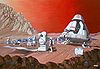
- ... that the first engineering analysis of a manned mission to Mars (artist's conception pictured) was made by Wernher von Braun in 1948, which included ten ships with seventy crewmembers?
- ...that water vapor is probably present in the tenuous atmosphere of Mercury, being brought to the planet by comets?
- ...that the Tagish Lake meteorite originally came from a part of the asteroid belt which existed when our solar system was being formed?
- ...that the trans-Neptunian object Eris (formerly known as 2003 UB313) is native to a distant region of our solar system known as the scattered disc?

No comments:
Post a Comment